Salary & Income · Tax Year 2026-2027
Hourly Wage Calculator Pakistan 2026-27
Enter your pay for an hour, a day, a week, a month or a year, with the hours and days you work, and see it in all five, before and after income tax. The tax is worked once, on the year, with the same FBR slabs and arithmetic as the income tax calculator, then spread back over each period. Nothing you type leaves your browser.
Sources last read on
Every period
Your pay by the hour, day, week, month and year
| Period | Gross pay | Income tax | Take-home |
|---|---|---|---|
| An hour | Rs 1,000.00 | Rs 49.42 | Rs 950.58 |
| A day | Rs 8,000 | Rs 395 | Rs 7,605 |
| A week | Rs 40,000 | Rs 1,977 | Rs 38,023 |
| A month | Rs 173,333 | Rs 8,567 | Rs 164,767 |
| A year | Rs 2,080,000 | Rs 102,800 | Rs 1,977,200 |
Quick answer · Tax Year 2026-2027
How much is an hourly wage after tax in Pakistan?
Income tax in Pakistan is charged on the year’s income, so an hourly wage is first turned into a year and taxed there. Rs 1,000 an hour for 8 hours a day and 5 days a week is 2,080 hours, or Rs 2,080,000 a year. On the Tax Year 2026-2027 salaried slabs that year carries Rs 102,800 of income tax, 4.9% of it, which leaves Rs 950.58 an hour and Rs 164,767 a month. The first Rs 600,000 of a year is taxed at 0%, which on this working pattern is Rs 288.46 an hour; that assumes the wage is your only income and no allowances or credits apply.
Worked examples · Tax Year 2026-2027
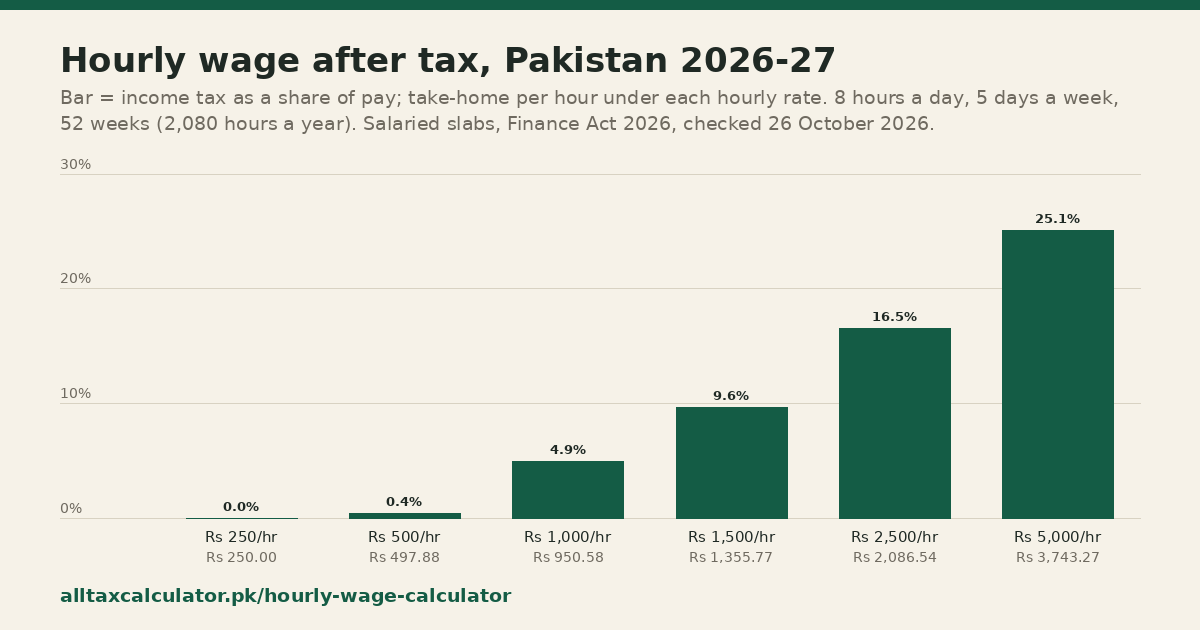
Hourly wage after tax: Rs 250 to Rs 5,000 an hour
| Rate an hour | A year | Income tax a year | Tax as a share | Take-home an hour | Take-home a month |
|---|---|---|---|---|---|
| Rs 250 | Rs 520,000 | Rs 0 | 0.0% | Rs 250.00 | Rs 43,333 |
| Rs 500 | Rs 1,040,000 | Rs 4,400 | 0.4% | Rs 497.88 | Rs 86,300 |
| Rs 1,000 | Rs 2,080,000 | Rs 102,800 | 4.9% | Rs 950.58 | Rs 164,767 |
| Rs 1,500 | Rs 3,120,000 | Rs 300,000 | 9.6% | Rs 1,355.77 | Rs 235,000 |
| Rs 2,500 | Rs 5,200,000 | Rs 860,000 | 16.5% | Rs 2,086.54 | Rs 361,667 |
| Rs 5,000 | Rs 10,400,000 | Rs 2,614,000 | 25.1% | Rs 3,743.27 | Rs 648,833 |
Rs 250 an hour comes to Rs 520,000 a year, inside the Rs 600,000 nil band, so no income tax is due; Rs 500 an hour is the first rate in the table that pays any, Rs 4,400 a year. Doubling a rate more than doubles its tax, because the extra pay falls in higher slabs: Rs 2,500 an hour pays Rs 860,000 a year and Rs 5,000 an hour pays Rs 2,614,000, 3.0 times as much.
Conventions
How the periods convert
| Pay for | To a year, multiply by | With the starting pattern |
|---|---|---|
| An hour | hours a day × days a week × 52 | 2,080 |
| A day | days a week × 52 | 260 |
| A week | 52 | 52 |
| A month | 12 | 12 |
| A year | 1 | 1 |
A month is a twelfth of the year, not four weeks: 52 weeks over 12 months is 4.33 weeks a month. Every period is converted through the year, never directly from one period to another. The year’s gross is rounded to a whole rupee, and that is the figure the tax is worked on.
Reading the result · Tax Year 2026-2027
An hourly wage is taxed as a year, then spread over the hours
Section 4 of the Income Tax Ordinance charges tax on taxable income for a tax year, and section 12(2)(a) counts pay, wages and overtime from an employment as salary. There is no rate for an hour or a day. The calculator therefore builds the year from your pay and working pattern, runs the slabs on it once, and divides both the pay and the tax back down. That is why the tax per hour can change when you change the hours: the same rate over more hours makes a bigger year, which can reach a higher slab.
The four-week month
The common shortcut, a weekly figure times four, drops 7.7% of the year, because 52 weeks are 4.33 weeks a month. At Rs 1,000 an hour on the starting pattern a four-week month is Rs 160,000 against Rs 173,333 here, Rs 13,333 short every month. 52 weeks are 364 days, so the one or two days that complete a calendar year are not counted as working time.
Salaried or non-salaried
Wages from an employer are salary and use the salaried slabs, provided salary is more than 75% of your taxable income. Freelance, contract or business income uses the non-salaried slabs instead: the same Rs 1,000 an hour carries Rs 314,000 a year as non-salaried income against Rs 102,800 as salary. The non-salaried option here assumes you have no salary at all; export earnings from IT and freelance work are taxed differently, on the freelancer tax calculator.
Which calculator answers which question
This page answers “what is my pay for one period worth in the others, before and after income tax?”. The income tax calculator answers “how is the tax on my monthly or yearly income worked out?”, slab by slab, with earlier tax years, allowances and deductions; enter the year’s gross from here and its tax is the same to the rupee. The salary tax calculator answers “what will my monthly payslip show?”, with EOBI taken off as well as income tax.
Where this stops
It assumes the same hours every week for all 52 weeks. If you work only part of the year, or your hours change, add up what you are paid for the year and enter it as a yearly figure; overtime counts as salary, so include it there. The take-home is after income tax only: EOBI, provident fund and other payslip deductions are not taken off, and allowances, deductions and tax credits are not applied. It treats the wage as your only income. An employer deducts tax under section 149 month by month on its estimate of your year, so a deduction on a payslip can differ from these figures in any one month even when the year agrees. This is a planning figure, not a return.
Sources
Where these rules come from
Sections 4 and 12(2)(a) and the rates in Division I of Part I of the First Schedule are read from FBR’s consolidated Income Tax Ordinance, amended up to 30 June 2026. The slabs are the site’s slab file for Tax Year 2026-2027, last compared with that text on 26 October 2026, and checked against KPMG’s brief on the Finance Act 2026. The 52-week and 12-month year is this page’s convention for converting pay, not a rule of law. Every figure above is arithmetic on the slab file, not typed in. How rules are checked is in the editorial policy; if something looks wrong, report it with the source.
FAQs
Hourly wage after tax in Pakistan: questions people ask
How do I work out my hourly wage after tax in Pakistan?
Turn the hourly rate into a year, work out the income tax on that year, and divide the tax back over the hours. Rs 1,000 an hour for 8 hours a day and 5 days a week is 2,080 hours and Rs 2,080,000 a year; the Tax Year 2026-2027 salaried slabs put Rs 102,800 of tax on that year, which is Rs 49.42 an hour, so Rs 950.58 of each hour is take-home.
How much is Rs 1,000 an hour a month and a year?
On 8 hours a day and 5 days a week, Rs 1,000 an hour is Rs 40,000 a week, Rs 173,333 a month and Rs 2,080,000 a year, counting 52 weeks and 12 months to the year. After income tax that is Rs 164,767 a month and Rs 1,977,200 a year. Change the hours and days in the calculator to your own.
How do I convert pay every two weeks into a year?
Multiply it by 26, the number of two-week periods in 52 weeks, or enter half of it as a weekly figure. Rs 28,000 every two weeks is Rs 728,000 a year; income tax on that year is Rs 1,280, so Rs 726,720 is take-home, or Rs 27,951 every two weeks.
What is the yearly income tax on a monthly salary?
Twelve times the monthly salary, taxed on the slabs for the year. Rs 150,000 a month is Rs 1,800,000 a year and carries Rs 72,000 of income tax in Tax Year 2026-2027, Rs 6,000 a month, leaving Rs 144,000 a month after tax. The income tax calculator gives the same figures with the slab-by-slab working.
Is there a separate tax rate for hourly or daily wages?
No. Section 12(2)(a) of the Income Tax Ordinance counts pay, wages and overtime from an employment as salary, and section 4 charges tax on the taxable income of the whole tax year. An hourly or daily figure only becomes taxable as part of that year, so its tax is the year's tax spread over the hours: 4.9% of Rs 1,000 an hour on the example above, 25.1% of Rs 5,000 an hour.
Does the take-home include EOBI or provident fund?
No. Income tax is the only deduction here, so it is pay after income tax. A payslip may also deduct EOBI, provident fund and other items; the salary tax calculator takes EOBI off a monthly salary as well.
Related tools
Turn a monthly salary into a payslip
The salary tax calculator takes income tax and EOBI off a monthly salary, on the same slabs as this page.
Open the salary tax calculator