The short answer. The return for Tax Year 2025-2026 was due on 30 September 2026 and FBR extended that to 31 October; anyone whose taxable income was above Rs 600,000, or who was charged to tax in either of the two previous years, has to file it; and a late return costs the higher of 0.1% of the year’s tax and Rs 1,000 for each day, with a floor of Rs 10,000 for a mostly-salaried person. The rest of this guide is the detail behind each of those.
The salary being paid in October 2026 belongs to one tax year; the return everyone has been told to file belongs to the previous one, and the two get mixed up every filing season. FBR names a tax year by the calendar year it ends in, so the twelve months from 1 July 2025 to 30 June 2026 are Tax Year 2026, which most people call 2025-26, and that is the year whose return is filed in 2026. This guide is about that return: who has to file it, when it was due and what an extension looks like, which slabs it is worked out on, and what being late costs. The figures come from the Ordinance and the site’s own slab data, not from memory.
Who has to file at all
Section 114 draws the line in two ways. The obvious one is income: anyone whose taxable income for the year was above the tax-free amount, Rs 600,000 for Tax Year 2025-2026, has to file. The less obvious one is a list of circumstances that require a return whatever the income: having been charged to tax in either of the two preceding years, owning immovable property of 500 square yards or more, or a flat of 2,000 square feet or more, owning a car with an engine above 1,000 cc, holding a National Tax Number, or an electricity bill above Rs 500,000 for the year. Salaried people are often surprised by the first of these; if your employer deducted tax last year, you were charged to tax, and a return is due even in a year your income fell below the line.
Section 118(2A) adds that a salaried person files electronically, through IRIS, with the proof of deduction and a wealth statement under section 116. The wealth statement is the part people leave to the last evening, and it is the part FBR’s system checks arithmetically: the change in your net assets over the year has to be explained by your declared income and outgoings. The wealth statement reconciliation calculator runs that identity before you submit.
The due date, and how extensions work
For an individual, an association of persons, and a salaried person filing through the portal, section 118(3) sets the due date at 30 September following the end of the tax year: 30 September 2026 for Tax Year 2025-2026. Companies with a June year-end have until 31 December.
Two kinds of extension exist and they are easy to confuse. Section 119 lets an individual apply in writing to the Commissioner, by the due date, for an extension on grounds of absence from Pakistan, sickness or misadventure, or another reasonable cause; the Commissioner may grant up to fifteen days, longer only in exceptional circumstances, and if refused the Chief Commissioner may grant a further fifteen. That is the extension for you personally. The other is the general extension FBR announces by notification for everyone, which has happened in most recent years, sometimes more than once. A general extension moves the due date for the penalty rules below; it does not change the tax year or the slabs.
For Tax Year 2025-2026 FBR extended the date twice: to 15 October 2026 by Circular No. 3 of 2026-27 on 30 September, and to 31 October 2026 by Circular No. 4 of 2026-27 on 15 October, under section 214A (Dawn, 1 October; Dawn, 16 October). We found no further extension when this was written on 3 November 2026, so a return filed now is late under the rules below unless a later circular says otherwise; check fbr.gov.pk before relying on that. You can still file (you can always file); the question is what it now costs.
The slabs the 2025-26 return is worked out on
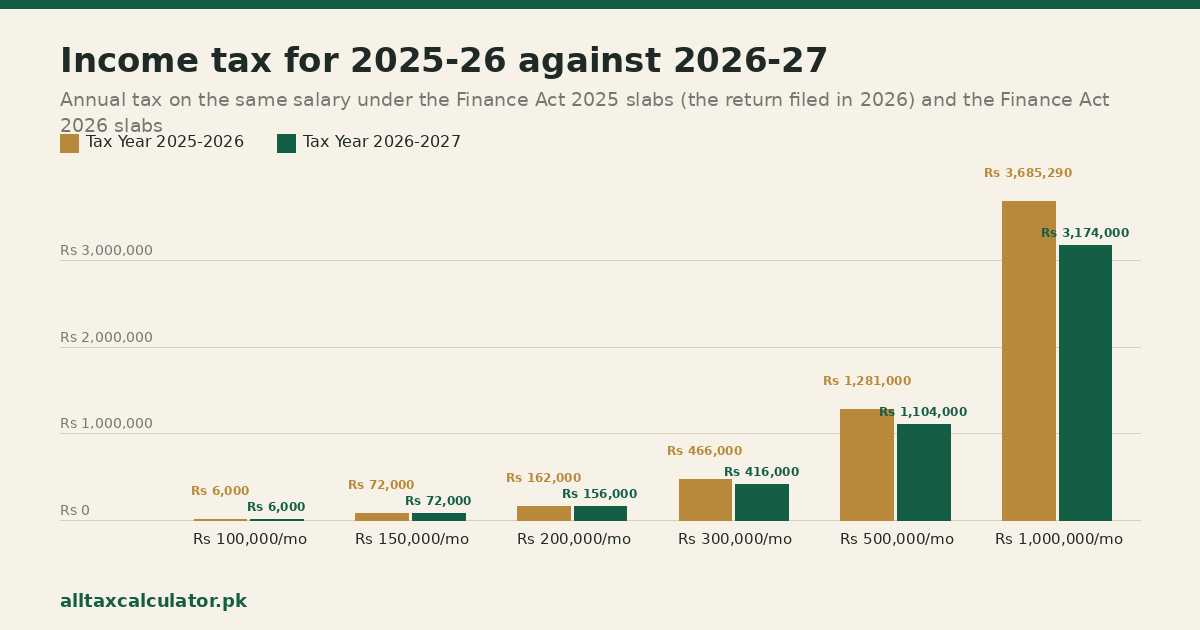
The Finance Act 2025 set the salaried rates for Tax Year 2025-2026, and they are not this year’s. The Finance Act 2026 cut the rates in three of the bands and split the top one into three steps, and the surcharge under section 4AB, 9% of the tax above Rs 10,000,000 of income, applied to salaried individuals in 2025-26 and no longer does. The table is the one the return is assessed on.
| Annual taxable income | Tax on the bands below | Rate inside this band |
|---|---|---|
| Rs 0 to Rs 600,000 | Rs 0 | 0% |
| Rs 600,000 to Rs 1,200,000 | Rs 0 | 1% |
| Rs 1,200,000 to Rs 2,200,000 | Rs 6,000 | 11% |
| Rs 2,200,000 to Rs 3,200,000 | Rs 116,000 | 23% |
| Rs 3,200,000 to Rs 4,100,000 | Rs 346,000 | 30% |
| Above Rs 4,100,000 | Rs 616,000 | 35% |
Two examples show how far the two years sit apart. On Rs 2,400,000 of salary for the year, the 2025-26 tax is Rs 162,000, against Rs 156,000 for 2026-27. On Rs 6,000,000 it is Rs 1,281,000, against Rs 1,104,000 this year, Rs 177,000 more, because 2025-26 taxed everything above Rs 4,100,000 at a flat 35% where this year climbs through three steps. If you have been using the current calculator to check last year’s figure, that is where the mismatch came from. The income tax calculator for 2025-26 opens on the right year and shows both figures side by side.
What to have in front of you
For a salaried return, five things. The tax deduction certificate from the employer: the section 149 statement showing salary paid and tax deducted, month by month. The bank’s certificate of profit and of the tax withheld on it. The withholding certificates for anything else the year carried: a vehicle registration, a property purchase, cash withdrawals, mobile and electricity bills if you want to claim them. The Zakat deduction slip from the bank. And last year’s wealth statement. Most of the tax a salaried person owes was deducted during the year; the return either confirms that or turns up a difference. The tax refund calculator adds up what was withheld against the tax due and tells you which way the difference runs, and the withholding reconciliation calculator is a checklist of the deductions a year usually carries, each with its section.
What filing late costs
Section 182, serial 1, charges a daily penalty: the higher of 0.1% of the tax payable for the year and Rs 1,000, for each day the return is late, with a floor of Rs 10,000 for someone whose income is 75% or more salary (Rs 50,000 for anyone else) and a ceiling of 200% of the tax payable. Since the Finance Act 2026 “tax payable” means the higher of this year’s tax and last year’s, and it is the tax charged for the year, not the balance left after deductions, which is why a salaried person who owes nothing extra can still face a penalty. The penalty is reduced by 75%, 50% and 25% if the return goes in within one, two or three months of the due date.
In rupees: a salaried person with Rs 100,000 of tax for the year who files 30 days late faces Rs 30,000 (the Rs 1,000 a day floor is what bites at that level of tax), cut to Rs 7,500 by the one-month reduction. The reduction is applied to the penalty after the floor, which is how the site reads the proviso; the Ordinance does not say the floor survives the reduction. Separately, section 182A keeps a late filer off the Active Taxpayers’ List for the year unless a surcharge is paid on filing, Rs 25,000 for an individual since the Finance Act 2026, and while off the list most withholding rates you meet are higher, many of them double: bank profit, vehicle registration and property transactions among them. For most salaried people those higher rates cost more than the penalty itself. The late filing penalty calculator works both out for your own figures, and the filer vs non-filer calculator shows what a year off the list costs.
The three mistakes that generate notices
Using this year’s slabs for last year’s return, which overstates or understates the tax above Rs 2,200,000. Leaving the wealth statement unreconciled, so the increase in assets exceeds what the declared income can explain. And forgetting income that was taxed at source and feels “done”, bank profit above all, which still has to appear in the return even though the tax on it was already withheld. All three come down to the right year’s figures and the certificates in front of you.
Sections 114, 116, 118, 119, 182 and 182A are read from FBR’s consolidated Income Tax Ordinance amended up to 30 June 2026; the Tax Year 2025-2026 slabs are the First Schedule as amended by the Finance Act 2025, checked against KPMG’s brief on that Act. Penalty and slab figures on this page are computed from the site’s data files. The general extension notifications FBR issues each year are not reproduced here; check the current one on fbr.gov.pk.