The first payslip of a new job in Pakistan, or the first one after a raise, is where most people meet income tax for the first time, and the number taken off rarely matches what they expected. Not because the tax is complicated. The arithmetic takes five minutes once you know three things: it is worked out on the year, not the month; only the slice of income inside each band pays that band’s rate; and your employer is deducting an estimate of the year’s tax in twelve pieces. This guide does the arithmetic by hand for two salaries, on the slabs in force for Tax Year 2026-2027, so you can check your own payslip against it.
Start with the slabs, and read them the right way
The Finance Act 2026 fixed the following rates for a salaried individual, which the First Schedule applies where salary is more than three-quarters of your taxable income. The first column is a band of annual income; the second is the tax on everything below that band; the third is the rate charged on the part of your income that falls inside it.
| Annual taxable income | Tax on the bands below | Rate inside this band |
|---|---|---|
| Rs 0 to Rs 600,000 | Rs 0 | 0% |
| Rs 600,000 to Rs 1,200,000 | Rs 0 | 1% |
| Rs 1,200,000 to Rs 2,200,000 | Rs 6,000 | 11% |
| Rs 2,200,000 to Rs 3,200,000 | Rs 116,000 | 20% |
| Rs 3,200,000 to Rs 4,100,000 | Rs 316,000 | 25% |
| Rs 4,100,000 to Rs 5,600,000 | Rs 541,000 | 29% |
| Rs 5,600,000 to Rs 7,000,000 | Rs 976,000 | 32% |
| Above Rs 7,000,000 | Rs 1,424,000 | 35% |
The mistake almost everyone makes once is to take the rate of the band their salary lands in and apply it to the whole salary. That is not how it works. Someone earning Rs 2,200,000 a year is in the 11% band, but pays 11% only on the income above Rs 1,200,000; the first Rs 600,000 is tax-free and the next Rs 600,000 is taxed at 1%. The “tax on the bands below” column exists so you do not have to add those pieces up each time.
Worked example: Rs 150,000 a month
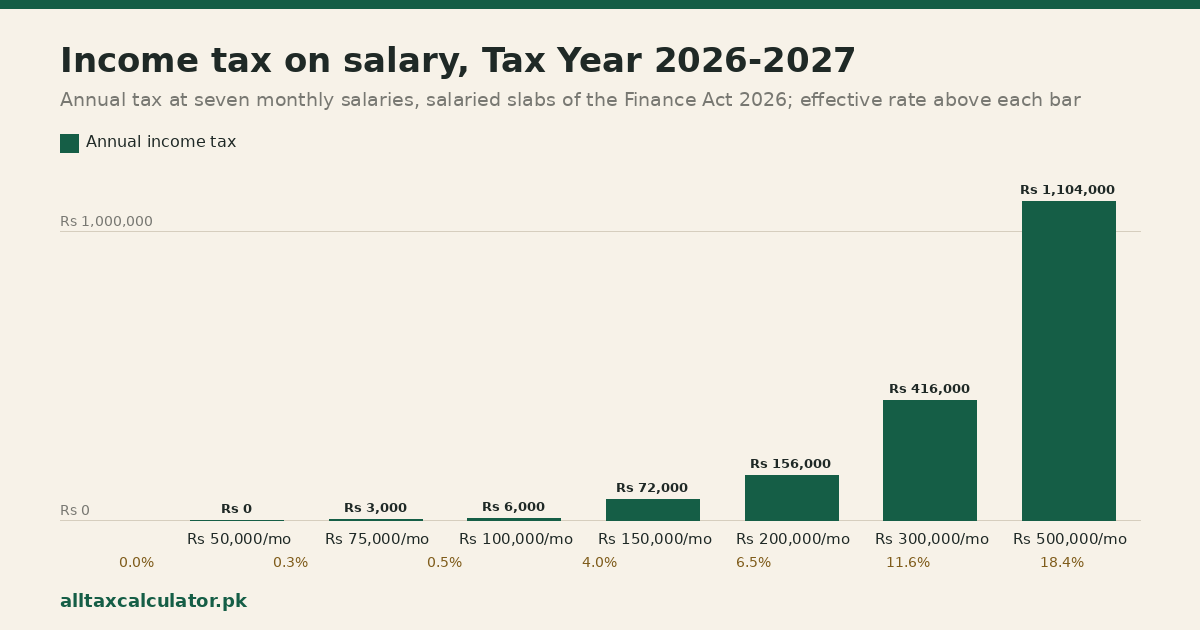
Take a monthly salary of Rs 150,000. Everything in tax runs on the year, so the first step is to multiply by twelve: Rs 1,800,000. That sits in the Rs 1,200,000 to Rs 2,200,000 band. The tax on the bands below it is Rs 6,000. The part of the salary inside the band is Rs 1,800,000 less Rs 1,200,000, which is Rs 600,000, and 11% of that is Rs 66,000. Add the two and the year’s tax is Rs 72,000. Divided by twelve, the payslip should show Rs 6,000 of income tax a month.
That is the whole calculation. The effective rate, tax divided by income, works out at 4.0%, well under the 11% on the label, which is the point of the slab system: the label rate applies to the top slice only.
Worked example: Rs 300,000 a month
Now Rs 300,000 a month, Rs 3,600,000 a year. This one lands in the Rs 3,200,000 to Rs 4,100,000 band. Tax on the bands below: Rs 316,000. Income inside the band: Rs 400,000, at 25% that is Rs 100,000. Year’s tax Rs 416,000, or Rs 34,667 a month, an effective rate of 11.6%. Double the salary of the first example, 5.8 times the tax: that is what “progressive” means in rupees.
What your employer is actually doing each month
Section 149 of the Income Tax Ordinance tells an employer to estimate your salary income for the whole tax year, work out the tax on it at the slabs, and deduct that tax at the same average rate from each payment. So the Rs 6,000 in the first example is not “this month’s tax”; it is one-twelfth of an estimate for the year. That has three consequences worth knowing.
First, a raise in the middle of the year changes the estimate, and the next payslips carry a catch-up for the months already paid at the old rate. Second, the same section lets the employer reduce the deduction for a few things if you give it proof: tax already withheld from you under other heads, and the credits for donations (section 61) and an approved pension fund (section 63). Third, if you have two employers, each estimates only the salary it pays and each gives you the tax-free Rs 600,000 again. On Rs 150,000 from one employer and Rs 100,000 from another, the first deducts Rs 72,000 for the year and the second Rs 6,000, while the tax on the combined Rs 3,000,000 is Rs 276,000; the Rs 198,000 difference arrives with the return. The two salaries calculator works this out for any pair.
The other line on the payslip: EOBI
Income tax is usually not the only deduction. The Employees’ Old-Age Benefits Institution takes a contribution from every insured worker, and it is small because it is not a percentage of your salary at all. Section 9B of the EOBI Act sets the employee’s share at 1% of the minimum wage, and the Federal Government’s minimum wage from 1 July 2026 is Rs 40,700, so the deduction is Rs 407 a month whether you earn Rs 50,000 or Rs 500,000. The employer pays 5% of the same figure on its own account and may not take it out of your pay. On the Rs 150,000 example the take-home is therefore Rs 150,000 less Rs 6,000 of tax less Rs 407 of EOBI: Rs 143,593.
A provident fund deduction, where the employer runs one, is a different thing: it is your own money set aside, matched by the employer, and it comes back to you. It reduces the cash that reaches your account, not your tax. Punjab’s professional tax, where it is collected through the employer, is a flat Rs 200 a year for the residual class of persons assessed to income tax in the previous year, under the Punjab Finance Act 1977, and is not an income tax deduction either.
Why a bonus month looks so heavily taxed
A bonus is salary, so it goes into the year’s total and is taxed in the bands that total reaches. On the Rs 150,000 example, a one-month Eid bonus of Rs 150,000 raises the year’s income to Rs 1,950,000 and the year’s tax by Rs 16,500. Spread over the remaining payslips or taken from the bonus itself, that is 11.0% of the bonus, against an effective rate of 4.0% on the salary alone. Nothing special is being done to the bonus; those are the last rupees in, and they sit in the highest band you reach. The bonus tax calculator and the pay raise calculator do this for any figures.
What legitimately reduces the figure
Not much, and nothing that is free. Zakat paid under the Zakat and Ushr Ordinance comes off taxable income in full under section 60: on the Rs 300,000 example, Rs 100,000 of Zakat saves Rs 25,000 of tax, because it comes off the top band. A contribution to an approved pension fund under the Voluntary Pension System earns a credit at your average rate on up to 20% of taxable income (section 63), and donations to approved recipients earn the same kind of credit on up to 30% (section 61). The tax saver calculator shows what each is worth on your income and how much room is left under each cap.
Which payslip items are taxable
This is where most payslip mismatches come from. Section 12(2) makes salary include every allowance an employer provides, house rent, conveyance, utilities and the rest, with one carve-out: an allowance solely expended in the performance of your duties, and the section says that an allowance paid monthly on a fixed basis does not qualify. The one allowance with its own exemption is medical. Clause (139) of Part I of the Second Schedule exempts free medical treatment or hospitalisation provided by the employer, and reimbursement of medical or hospital bills, where the terms of employment provide for it and the bills carry the hospital’s National Tax Number and the employer’s attestation; where the terms of employment provide neither, a medical allowance is exempt up to ten per cent of basic salary. A conveyance allowance paid in cash is taxable salary; a company car is a perquisite valued under its own rule. If your taxable figure on the payslip is higher than your basic pay, this is usually why.
Checking your own payslip
Multiply your gross taxable salary by twelve, find the band, add the base tax to the rate times the slice inside the band, divide by twelve. If the payslip is a little higher, the usual reasons are a raise earlier in the year, a bonus already paid, or an allowance the employer has treated as taxable that you assumed was not. If it is lower, the employer may have applied a credit you gave it evidence for, or it is simply estimating a lower annual figure, in which case the difference will arrive at the return. The income tax calculator runs these slabs for any salary and shows the slab-by-slab working; the salary tax calculator adds EOBI and prints the payslip as a monthly and annual table.
Rates: Division I of Part I of the First Schedule; section 12(2) and clause (139) of Part I of the Second Schedule for allowances; the salaried table as amended by the Finance Act 2026, checked against KPMG’s brief on the Finance Act 2026; sections 149, 60, 61 and 63 of the Income Tax Ordinance 2001, FBR’s consolidated text to 30 June 2026; EOBI Act sections 9 and 9B with the minimum wage of Rs 40,700 (Finance Division O.M. of 21 August 2026). Figures on this page are computed from the site’s slab and EOBI data files, the same ones the calculators use.